Friday, June 3, 2011

Soque Bulletin - June 3, 2011 - "5 in 5" FINAL DAY

SOQUE BULLETIN
June 3, 2011

It's Day 5 of our "5 in 5" FUNDRAISING WEEK !
Please help us reach our goal to raise $5,000 towards our 5 major programs in 5 days
TODAY is a great day to join or donate to the SRWA!
and / or Join us for the Soque Celebration at Sutton Mill TONIGHT 6PM!
It's hard to practice sustainabilty without getting your hands dirty. Linda Lovell of Moonshadow Farms in Demorest
taught us that lesson and many more during her free workshop on planting heirloom tomatoes among other crops
at the Clarkesville Green Way Garden - April 21st.

The 5 Programs of the Soque River Watershed Association

As part of our "5 in 5" fundraiser (to raise $5,000 in 5 days) we're taking a stab at explaining who we are at the SRWA and what our little group is trying to do in the Habersham community and beyond. Hopefully it's coming together as we explain each program one by one. We're running out of time (….as usual) but today we're excited because we're explaining not only our newest program, but the one that is growing the most rapidly and has the potential to make the biggest impact on the community.

PROGRAM #3 - SUSTAINABILTY MODELS

As the SRWA has evolved over the years, one of the things we've realized is that each one of us is going to have to learn some new skills, change our preconceptions about how thing work, and experiment with different practices and behaviors if our local environment is going to have a chance at truly staying pristine and sustainable. With that in mind we set about building our Sustainability Models Program with a goal to demonstrate a full range of sustainability practices that can be implemented by watershed community members at various scales. A principal focus of the program has become “learning to grow things in the service of nature” via rain gardens, streambank vegetation, upland stabilization, and organic food production. Don't worry we'll explain what we mean by each of those. Additional projects focus on water efficiency and re-use and promoting sustainable land-based businesses via a local food market, a community garden, and incorporating more sustainable "land based" products into our local economy. Whew! Where should we start?

1) Water Conservation and Re-Use
Since many economists and political theorists anticipate that dwindling water supplies will be a central crisis of the 21st century, our area should heed this warning as we're likely to be one of the earliest to feel the crunch of water shortages. Why is that? Well, it's a blessing to live up in the mountains, but what that means is that all the water available to us originates from a very small area, beginning at the tops of them hills.

The SRWA aspires for Habersham County to be both a statewide leader in water conservation, and one day a national leader in sustainability practices for water use and water management.  We're not there yet, but here's our rapidly growing array of practices that we think all of us should be pushing to implement in both small and large ways. As we talk about each one we really want to highlight the incredible group of partners that we work with. Even though we talk about the programs of the SRWA, all of these efforts are partnerships with people and organizations in the community.

#1 - Rainbarrels
#2 - Cisterns
#3 - Rainwater capture for infiltration
#4 - Rainwater capture for indoor re-use

RAINBARRELS
Rainbarrels are a great starting place for water reduction and reuse around the home. Thanks to our long-time collaborations with Coca-Cola and Upper Chattahoochee Riverkeeper, the SRWA has been able to make rainbarrels widely available for a very low cost $40 for SRWA members and $50 for non-members. Last summer on July 7th we partnered with Tallulah Falls and fitted 80 barrels, and distributed nearly 30 in an effort to put a rainbarrel on every home in Tallulah Falls. This year we're deepening our partnership with Habitat for Humanity by not only making barrels available there on a regular basis but also including literature on how to install and installation kits which include all the equipment needed to get them attached and working.


CISTERNS
Rainbarrels are a good start, but cisterns have incredible potential for capturing large volumes of rainwater, both for use as irrigation water (the easiest use) and even for re-use for non-potable uses in your home, requiring some additional plumbing and filtration. Last August the SRWA installed our first model cistern at Fairview Elementary for use as irrigation water for the Fairview School Garden. The Board of Education, Melissa Maughon, A-1 gutters, Bruce Colston, Stormwater Systems of Cleveland, and the welding school at North Georgia Tech College all contributed to this project.


RAINWATER CAPTURE FOR INFILTRATION
Until very recently we've thought of water that lands on buildings and parking lots as a problem to get off the site via stormpipes as rapidly as possible. Society is slowly realizing the costs of stormwater, both in maintaining stormwater system infrastructure with tax dollars, then the subsequent damage it has to streams (bank scouring, erosion, habitat destruction), and last but not least the loss to our long-term water supplies. We've been trying to spread the word that the biggest water supply we will ever have isn't in a reservoir, or even in our rivers….but stored in the ground. By pushing water off of the landscape with impervious surfaces, we're actually reducing our long-term water supply. That's why we want to take rainwater and turn it into groundwater via infiltration, thus preventing it from becoming stormwater. We do that by encouraging infilration with a very pretty little device we call a Rain Garden. In the last year we've completed two of them, one at North Georgia Technical College and the other we just completed in Cornelia last week. We'd like to continue to see them and other rainwater capture systems both small and large all over the county. Thanks to our partners NGTC, Wilcorps, City of Cornelia, the Cornelia Garden Club, Boy Scouts, Roteract Club and everyone else who contributed time, sweat and money to these model projects.


RAINWATER CAPTURE FOR INDOOR REUSE
As we've been experimenting with some of these smaller versions of model practices we've also been looking for just the right opportunity to promote them at a grander scale. Even before the County Commissioners decided to build the new courthouse at the Old High School site, the SRWA wrote and submitted a grant for $100,000 to make the new courthouse the premiere model for innovative water management. The grant outlined how to achieve stormwater infiltration so that the building and parking lots would generate the minimum amount of surface runoff, and maximize infiltration. To top it off, we proposed that a portion of the rainwater falling on the roof of the courthouse should be captured, treated and then used to flush commodes in the courthouse restrooms. The idea was modeled after a similar project recently completed at a school in Athens. Though we didn't receive the grant, we believe it's still a great idea that we hope will be incorporated into the courthouse designs. Based on the Athens model the savings in water use and sewer costs would actually pay for the additonal cost of the project within 10 years. If you're interested in this project check out the project summary attached and let our Commissioners know what you think. Janeann Alison the County Manager has been very receptive to the idea and encouraged us to write the initial proposal.

That's it for our water conservation and re-use projects….now on to……

2) Promoting Sustainable Land Based Businesses
We may be one of the only watershed groups in the country to be actively engaged in promoting sustainable land based businesses as a major component of our work, but we think it's what all watershed groups should be doing, especially in rural areas. Watersheds and the quality of their waters are the culmination of every landuse in a watershed. All land uses have an impact on the watershed, some are good and some are less good. We'd like to see more and more people able to generate a good income, even if it's only a portion of their income from their land in ways that are also sustainable to the watershed landscape. Essentially that means that the land is being managed in ways that builds up the soil, increases water infiltration and reduces runoff and erosion, retains nutrients and even builds nutrients on the site. These are essentially farming skills, and we think that everyone needs to have them even if they aren't farming. We also want our community to have high quality locally produced products that are coming from beautiful and conservation minded landscapes.  We think that if people buy local from sustainable land based businesses they are more likely to understand what good land management entails, hold in high esteem those who set a good example, and even learn from them how to treat their own properties. Here are our humble efforts thus far towards these goals:

#1 - The Clarkesville Green Way Garden
#2 - Northeast Georgia Locally Grown
#3 - Community Cannery / Kitchen
The Clarkesville Green Way Garden
The Clarkesville Green Way Garden on the Greenway behind the Mill is our simple way to maintain the agricultural heritage of one of the richest bottomlands in the whole county while also teaching how to garden or farm organically without chemicals and encouraging sustainable practices of all kinds. The garden has 28 plots (10x20) and over 40 gardeners. The techniques we are able to demonstrate include a gravity feed irrigation system aided by a rainwater capture pond, use of organic fertilizers (kelp meal, and mixes that include alfalfa, feather meals), controlling bugs and weeds with attention rather than chemicals, solar powered deer fence, crop diversity, and introduction of potential new cash crops such as sunflowers grown for cooking oil. The garden has allowed us to cultivate some very rich relationships with farmers, and other ag related businesses and interests in the community and has become an incredible social network for generating new ideas towards sustainability.


The Northeast Georgia Locally Grown market has become a remarkable success. In just over one year the market has generated nearly $40,000 in sales of local fruits, veggies, meats, dairy, bread, flowers, soaps, eggs, and dozens of other items all produced in Habersham, Rabun or adjacent counties. There are nearly 30 farms participating and weekly sales are averaging $1,200 with about 40-50 customers per week. Perhaps the most remarkable outcome of the market other than everyone's dinners being more interesting, nutritious and sustainable is that the local farming community has come up with dozens of collaborative ideas that we're beginning to implement to increase sales, increase information exchange, increase our ability to grow sustainability and to simply grow more local food better. If you haven't experience the market, click on the logo and learn all about it.

Community Cannery / Kitchen
Building on the success of the Locally Grown market, SRWA recently began an extremely promising dialogue with the Habersham County School System and Board of Education about the potential for a new cannery to be built at the new high school to have a community kitchen component where local food producers could process and resell locally grown food. Though we're in a very early stage of exploring this idea, numerous staff with the GA Dept. of Education, Dept. of Agriculture and Georgia Organics think that Haberhsam County has the opportunity to set a new model for canneries in the state so that both home canners for personal use and farmers who want to create "value added" products can utilize the same facility maxmizing the use and benefit to the community and increasing the interaction between local farmers and end users. Food processing is a vital component to sustainable land based businesses greatly increasing the economic opportunities.

Moving right along to our final Sustainability Model component…..

3) Growing Vegetation
It almost seems silly to have to say that growing vegetation is essential to sustainablity, but the SRWA has realized more and more how much we don't know about how to get things to grow in order to restore areas that have become denuded or degraded. We're rapidly learning everything from achieving good soil chemistry, to soil amendments, to grasses, and riparian plants, rain garden plants, irrigation systems, greenhouses, you name it, we need to know it because you've got to grow things to achieve sustainability.

#1 - Upland Site Stabilization
#2 - Grow Something Green CAMPAIGN

Upland Site Stabilization
Areas with denuded vegetation aren't good for watersheds….or aesthetics for that matter. They often contribute sediment, don't allow rainwater to percolate into the ground, increase temperatures, and just generally don't add anything to our enviroments. One of our biggest supporters in working to restore denuded sites has been the Habersham County School system. Several of their schools lack permanent vegetation and in collaboration with the NGTC Turf and Horticulture departments and the County Extension agent we've created a plan to balance soil chemistry, amend soils, and plant grasses so that the school's will be green and productive. Pictured above is David Barnes one of our farm partners spreading lime at Fairview Elementary where we plant to plant and irrigate Bermuda sometime in the coming months.

Grow Something Green CAMPAIGN
Our absolutely newest project….so new we don't even have a photo yet is our “Grow Something Green” Campaign which is an expansion of our upland stabilization efforts. The goal of the campaign is to identify areas blighted by unstable soils and launch community projects to amend the soils, then plant grass and native and flowering plants to stabilize the soil, increase rainwater infiltration and beautify our community one site at a time. We're working to find the ideal site to launch this effort and a spare moment to squeeze it in our schedule, but when it happens we hope it'll inspire everyone to cover red soils in a blanket of green and in the process learn how to grow vegetation.

That's it for our Sustainablity Models Program - we'll discuss our last two programs the Policy and Compliance program and our Conservation Lands program at the "5 in 5" party tonight, and in a future e-mail.


THANKS FOR SUPPORTING OUR
"5 in 5" FUNDRAISER THIS WEEK

There's numerous ways to help us make our goal by making a contribution

#1 - Make a donation or new membership gift ONLINE by clicking the leaf
#2 - Pledge an amount and you can send a check by mail
#3 - Pledge an amount and you can bring your check to our "5 in 5" party on Friday


** No parking at Sutton Mill **
ALL PARKING IS AT North GA Tech and we have a 18 passenger bus running shuttles every 10 minutes


#4 - Buy lots and lots of raffle tickets - Check out the full list of items below - tickets are $5

Here's our awesome RAFFLE ITEMS

Item and Value
Business
Owner / contact
Homemade cutting board
Randy Moser
Randy Moser
Corn husk Doll by
Sarah Samsel
Sarah Samsel
Sarah Samsel
$20 gift certificate of Local Food from Locally Grown
Locally Grown
Justin Ellis
Artisan Fly Box and Trout Flies by Ron Thomas ($65 value)
Bob Parker
Bob Parker
Metal Fish ($40 value)
Soque Artworks
Rush Smith
Headwaters Print ($50 value)
The Saturday Shop
John Kollock
Black Dog Gift Certificate (value $25)
Black Dog

Canoe Rental on the Chattahoochee for 2 (value ?)
Wildwood Outfitters /
Gale Builders
Dave and Beverly Gale
Raft Rental on the Chattahoochee for 4 (value ?)
Wildwood Outfitters /
Gale Builders
Dave and Beverly Gale
LL Bean Fly Rod
Trout Unlimited
Brian Sandven
Mark of the Potter Vase ($40 value)
Cobalt blue vase with copper red shoulder
by Maraiah Wenn
Mark of the Potter
Michael Foust
Vintage Metal Sign ($70 value)
Cottage Garden

One Month Free Gym Membership ($69 value)
Performance Gym
David Provine
Ridges Resort and and Club on Lake Chatuge in Hiawasee ($200 value)
Headwaters Realty
Dale and Jean Holmes
St Croix Imperial Fly Rod – 8’ 2 pc 8 wt ($229 value)
Steven Patrick
Steven Patrick
(you can buy tickets even if you can't attend by sending an e-mail request and paying online)

Hope to see you tonight!


Justin Ellis
Executive Director
Soque River Watershed Association
706-754-9382

Wednesday, June 1, 2011

Soque Bulletin - June 1st, 2011 - "5in5" Week

SOQUE BULLETIN
June 1, 2011
It's Day 3 of our "5 in 5" FUNDRAISING WEEK !
Please help us reach our goal to raise $5,000 towards our 5 major programs in 5 days
Join us Friday, June 3rd for the Soque Celebration at Sutton Mill - Donation & RSVP form attached

The tour of sustainable water supplies last Thursday had over 25 attendees.
Though the summer heat dwindled our numbers by our last stop at Habersham Mills Lake
we had excellent discussions about the potential of the lake to meet future water needs.


The 5 Programs of the Soque River Watershed Association

As part of our "5 in 5" fundraiser (to raise $5,000 in 5 days) we're taking the opportunity to explain who we are at the SRWA and what our little group is trying to do in the Habersham community and beyond. Everyday this week we're going to describe another program of the SRWA. Yesterday we explained our Protection and Restoration program. Today we're going to describe one of our lesser known projects, but one that is interwoven into everything that we do.

PROGRAM #2 - RIVER AWARENESS PROGRAM

The goal of the River Awareness Program is to increase residents understanding, appreciation and enjoyment of local water resources while exposing them to direct actions that will increase the environmental, social and economic sustainability of the Northeast Georgia Region. The River Awareness Program is a great starting place for looking at the broader view that the Soque River Watershed Association has in promoting conservation and stewardship. In order to fully protect water resources we have to be exposed to information, ideas, and practices that are impossible to fully grasp until you've seen them. But seeing novel conservation practices is just step one, thinking about them, discussing them with other community members, and tailoring them to our own local conditions all require exposure, sometimes repeatedly. Our River Awareness Programs are as much about the networking and brainstorming as they are about expanding personal knowledge. Cultivating relationships in the presence of fun and novel ideas is a vital component to river conservation and sustainabilty.

1) The Sustainability Tour Series
Social and educational outings have always been an important part of the SRWA's activities. But beginning last year we began a much more organized and strategic approach to our get togethers. If you haven't already heard of them you're probably wondering what pray tell are your  quarterly “Sustainability Tours”? Well simply put, sustainability tours are outings into the watershed (and beyond) to learn about practices and places that work to enhance the long-term use, protection, and enjoyment of our natural resources. Each season we  organize a new theme with new locations to observe the creativity and ingenuity of our fellow neighbors in living “sustainably.” When we first started last year, some of the themes we thought we'd explore were things like: using native plants in the landscape, energy and water conservation, green building, and sustainable agriculture. Since then we've had five great tours that we thought we'd recap::


#1 - Grist Mills and Mountain Streams - SPRING- April 24, 2010
“Grist Mills and Mountain Streams – putting water to work then and today.”
At one time, grist mills, where grain is ground into flour by harnessing the power of falling water, were a vital hub of economic and community life.
Today these still standing mills are a great reminder and one of our best links to a time when water, work and local food were still interconnected.
SITES: Loudermilk, Sutton, Nora and Watts Mill

#2 - Tour of Sustainable Farms -SUMMER- June 26, 2010
Finding local foods from farms that practice sustainable practices is getting just a little bit easier each year in the North Georgia Mountains.
However, its still not easy to picture exactly how these farms practice sustainability.
That was the purpose of this Tour of Sustainable Farms.
SITES: GA Mtn Honey, Trillium Farms, Indian Ridge Farms

#3 - Bike Tour of Proposed Clarkesville Greenway - FALL - September 25, 2010
The Greenways bicycle tour was a “carbon free” event promoting alternative transportation and walking and cycling trails
The goal of the Bicycle Tour was to see first-hand the incredible potential Clarkesville has to become a pedestrian friendly, green city
filled with people enjoying nature by exploring the proposed 6 mile Clarkesville Greenway.
"We felt this was the green way to see the Greenway, and it’s the fun way too.”
SITES - Clarkesville Greenway - 6 mile proposed loop

#4 - Tour of Sustainable Streambanks - WINTER - January 29, 2011
One of our favorite tours was the streambank tour, intended as an introduction to the basic principles of stream morphology,
or how streams change shape through time as a product of their water flow,  sediment yield and disturbances in surrounding land use.
We saw three sites that have or will implement Natural Channel Design.
SITES: Clarkesville Greenway, Whiting Property, Jackson Bridge, Wilbanks Property

#5 - Tour of  Sustainable Water Supplies - May 26, 2011
The Tour of Sustainable Water Supplies  was an in-depth exploration of exactly how water gets from the stream, to your home, then back to the stream again,
and how individuals and municipalities can implement conservation practices along the way.
The tour highlighted Habersham County’s municipal water suppliers, the sources of their water,
how they manage long-term water quality and quantity, and the costs of building and maintaining water infrastructure.
SITES: Clarkesville Water Plant, Cornelia Water Plant, Habersham Mills Lake.

We'd love to hear your suggestions on tours to plan in the future. Mark your calendars for the Tour of Sustainable Farms scheduled for Saturday, July 16th.

2) Publications
The SRWA is slowly expanding our capacity to publish small, but information packed publications on nearly all the topics and projects that we're involved in. We hope to have many, many more of these in the years ahead, as there are countless topics that we'd like to explore. Here are the four we currently have. You can click on the images below to download the associated PDF. Or visit our Publications Page on our website.


If you have a suggestion of a publication that you'd like to see in the near future, please give us your ideas.

3) Workshops
The SRWA hasn't held that many workshops yet, but we have a strong interest in developing more and more in-depth trainings and potentially even formal classes for college credit. So far we've focused on Rainwater Harvesting and we'll soon have a Streambank Restoration workshop in June. Stay tuned for more trainings in the near future.

4) Signage
There are so many occasions to appreciate the subtleties of the watershed such as noticing a small tributary, or the ridgeline separating one drainage from another. To help bring these details into sharper focus the SRWA is teaming up with Lewis Canup and the Habersham County Commissioners (as well as GA DOT) to place signs at bridge crossings that let you know which stream or river flows beneath as you drive over. We’re excited to be partnering with the County on this project and now that we've raised $1,000 for this project through our Winter Campaign, we plan to get on the County Commissioners agenda over the summer to get permission to pay to manufacture and install about 6-10 of these signs at strategic locations.

5) Youth Education
Our Watershed Coordinator, Duncan Hughes has done an incredible job of organizing numerous youth education projects all over the county, from classroom and library presentations to a day-long Soque Field Day for every 6th Grader at North Habersham 6th Grade Academy. We also host a free week long Soque Camp for 6th graders each summer. For more information on Youth Education programs give Duncan a shout sometime at dhughes@northgatech.edu


Leon Brotherton, a trout fisheries biologist with DNR shows 6th graders
how to capture and identify fish collected from backpack shocking at the 6th grade acadamy field day.


Well that's it for the RIVER AWARENESS PROGRAM. We hope you enjoyed this program description. We've got 3 more coming!

We're attaching our Soque Celebration Party at Sutton Mill party flier so please don't forget to make a donation this week towards our "5 in 5" fundraiser. Please help us make our goal to raise $5,000 in just 5 days. Even if you can't make the party……We need your help now. Especially if you enjoy the Bulletins but aren't a member. Now is the time to join. Don't delay. Click on the DONATE button and make an online donation today, or just print out the form and mail it in.


And don't forget all new members to the Association are invited to our Free Soque Party at Sutton Mill for supporters.
You have to be a supporter to get in, but it's a cause well worth supporting.


Justin Ellis
Executive Director
Soque River Watershed Association
706-754-9382

Tuesday, May 31, 2011

Soque Bulletin - May 31st, 2011 - "5 in 5" KICKOFF!


SOQUE BULLETIN
May 31st, 2011

THIS WEEK IS OUR "5 in 5" FUNDRAISING EVENT !
Please help us reach our goal to raise $5,000 towards our 5 major programs in 5 days - THIS WEEK
Our Soque Celebration at Sutton Mill is this Friday, June 3rd - see donation, RSVP form attached

On Monday, May 23rd the Cornelia Rain Garden was officially completed thanks to
the efforts of the Cornelia Garden Club, Boys Scouts, City of Cornelia and the SRWA.
Drive by the backside of the community center and take a look!


The 5 Programs of the Soque River Watershed Association

Once a year we like to try and slow down long enough to really share what it is we do here at the Watershed Association. Everytime we meet someone new the first question they ask is "What do you do?" and as you'll see, it's a complicated answer. Everyday this week we’ll send out a bulletin that highlights a different program area of the SRWA. This is a great way for us to reflect on each of our project areas, and also allows us to share these program details with everyone both our supporters, and hopefully some of our future supporters as well. If you like what we’re doing please consider a membership or an extra donation this week to help us meet our fundraising goals.

Here's a quick snapshot of the 5 program areas we'll cover this week
#1 - Protection and Restoration
#2 - Sustainability Models
#3 - River Awareness
#4 - Policy and Compliance
#5 - Conservation Lands

Ok, here goes with program #1


PROGRAM #1 - PROTECTION AND RESTORATION


The Protection and Restoration Program is the principal focus area of the Association. The goal of this program is to protect existing water quality and to restore impaired water quality through “on the ground projects” that address the central causes of impairment to the Soque Watershed (bacteria, sediment and stormwater). The Soque River is actually considered impaired by the state's water quality standards for a 34 mile section of the Soque mainstem due to fecal coliform bacteria, and for a nine mile section of the Hazel Creek subwatershed for sedimentation. The Association has several specific projects designed to help us identify, reduce or eliminate these sources of water quality impairment, and a number of special projects that help prevent water quality projects before they start.

1. Comprehensive Water Quality Monitoring
The SRWA been conducting continuous water quality monitoring studies (under the leadership of Duncan Hughes) for over seven years. These studies allow the SRWA to focus "water quality improvement projects" at strategic hotspots where we know water quality problems exist.

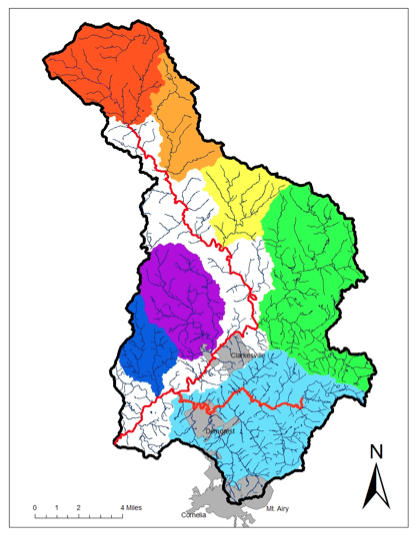
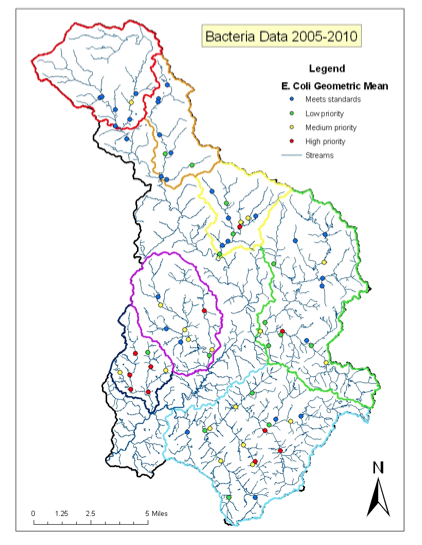
The first map indicates in red the sections of impaired stream in the Soque Watershed. The second map is a hotspot locater for fecal coliform bacteria, identifying specific stream sections impaired for fecal coliform bacteria.

This year the Association has expaned our monitoring to include a new and novel "Sediment Source Assessment" methodology for the Hazel Creek sub-basin. We're the first watershed group in the state to develop a strategic approach to identifying sediment hotspots at the small catchment scale, and it should really help us key in on projects that reduce the most sediment for the least amount of money. For those who are super interested in technical details such as these check out our publications link on our website at http://www.soque.org/publications.html and look under technical papers.


2. Cattle Exclusion / Cattle Crossing / Upland Watering Projects
By far our most successful efforts to reduce fecal coliform bacteria and sediment from the Soque basin are the result of our collaborations with 15 local farms on cattle exclusion projects. Since 2008 the SRWA as part of our multi-stakeholder Soque Partnership collaborative have installed 15 farm projects that have fenced 44,750 feet of streams, installed 7 stream crossings, and drilled 4 wells on 765 acres of farmland. As a direct result of these efforts by local farmers to implement voluntary best management practices many of the red dots on that fecal coliform hotspot map have been eliminated and a 29 mile segment of the Soque is expected to come off of the state's impaired waters list in 2012 as a result. We're quite proud of the results of this collaboration with farmers, and are now looking for the next round of 15 project participants, especially in the Hazel Creek part of the basin.

On March 13th, about 25 people came our a tour of farm projects including Mr. Lamar Whitings recently completed cattle crossing.
The projects are the result of a collaboration of over 20 groups called the Soque Partneship which receives federal funding through the EPA and EPD.

One of the farm partners Bruce Colston summed up the effort. "This project has helped me out all the way around. It has reduced mud into my streams and I've gotten more use out of my hay. Our natural resources are being used up faster than we can protect them. I want the Soque to be the cleanest river in the United States. I want my great-grandkids to be able to farm here and know that I helped keep the water clean for them."

3. Riparian Revegetation and Streambank Restoration
The riparian zone is the land area immediately next to a stream or river and is considered a critical zone for maintaining river bank stability with trees and vegetation providing root mass holding soils in place, shade which cools stream temperatures, and acts as a buffer to treat and remove pollutants flowing from upland sources.

Over the last year the Association has ramped up our ability to promote riparian revegetation of streambanks and even to re-build failing streambanks when they are degraded too badly to restore themselves. We now have a willow harvesting project during the winter and early spring in which 12-18 inch long stakes are cut from existing willows and then replanted where they can quickly reroot and rapidly lay out roots that hold streambank soils in place. The most common cause of streambank failure is a lack of vegetation in the buffer. Therefore one of the best things you can do to restabilize a failing streambank is to either allow natural vegetation  to recolonize an area, or to plant appropriate riparian revegetation to help nature along in its repair work.


March 15th, SRWA staff and volunteers plant willows at David Barnes farm.

Streambank restoration can be complicated business, that's why we're building a Natural Channel Design streambank restoration coming up in just a few weeks to demonstrate how to do it best. While armoring degraded streambanks with rock has been the norm in the past, it often fails to take into account how streams behave naturally and why the stream is degrading in the first place. Natural channel design is a technique that re-engineers streams into a natural and stable form that will hold up for decades to come. This project will be in a highly visible location along Hwy 115 going towards Cleveland. We're fortunate to have the expertise of Greg Jennings and his Streambank Restoration unit at NC State University who have engineered the project and will be overseeing construction. This project will be easily seen from the road beginning June 20th and then we'll have a select group of about 20-40 attend an "in construction" workshop on June 24th.

Lamar Whiting's farm and 500 foot reach of stream will be the site of our Natural Channel Design restoration project beginning June 20th.


THANKS FOR SUPPORTING OUR
"5 in 5" FUNDRAISER THIS WEEK

There's numerous ways to help us make our goal by making a contribution

#1 - Make a donation or new membership gift ONLINE by clicking the leaf
#2 - Pledge an amount and you can send a check by mail
#3 - Pledge an amount and you can bring your check to our "5 in 5" party on Friday


#4 - Buy lots and lots of raffle tickets - we'll give the full list of items tomorrow - tickets are $5
#5 - It's not too late to donate a raffle item

Thanks for all your interest and support of efforts. Give our new RSVP automatic form a shot if you know you want to attend the 5 in 5 party! Tomorrow we'll describe our Sustainabiltiy Models Program so stay tuned.

Justin Ellis
Executive Director
Soque River Watershed Association
706-754-9382

Monday, May 23, 2011

Soque Bulletin - May 23rd, 2011

SOQUE BULLETIN
May 23, 2011

1) "Five in Five" awesome PARTY for all SRWA supporters Friday, June 3rd
2) Tour of Sustainable Water Supplies - Thursday, May 26th
3) Rain Barrel Fittings Day - postponed till parts come in


1) "Five in Five" awesome PARTY for all SRWA supporters Friday, June 3rd
You may have heard a little something about the SRWA's reputation for parties. They're usually somewhere on the scale between super fun and totally awesome!  Last year we found an ideal site for such adventures at the beautiful Sutton Mill, which of course is right smack dab on Sutton Mill Creek a tributary to Beaverdam Creek which is a tributary to…you guessed it the Soque River.

The "5 in 5" fundraiser is a fun way for us to raise $5,000 in 5 days for the Soque River Watershed Association. Each day of the fundraiser we'll highlight a different program of the SRWA so that by the end of the week you have a pretty good idea of all the myriad and sometimes unusual projects that we undertake in our efforts to make the Soque clean, vibrant, and hopefully innovative when it comes to water quality, water supply and sustainability. Along the way we hope you'll be inspired to help us make our fundraising goal through a special gift, gift membership for a friend, or any other number of ways. The "5 in 5" is also a great time of year for us to say thanks to all of you who are giving us the resources, the donations, the time, the encouragement, and the sheer force and influence of some of the coolest people around to make our community a stand out when it comes to conservation leadership.

That's why at the culmination of the "5 in 5" we like to throw a big free party in honor of all our supporters. This year we're kicking it up a couple notches with great Caribbean food cooked up by one of our newest friends and a native Caribbean herself, Gaby's of Toccoa whose dishes hail from her original home of Haiti. Gaby will be treating us to Jerk Chicken, Succulent Fried Pork with spicy coleslaw, vegetable rice, fried plantains and spicy cabbage. To make sure that spice is soothed cool we'll have some drinks featuring rum, coconut and/or mint. Ahhh!!!

We'll also have a great raffle featuring local restaurant gift certificates, artisan fly fishing ties, Local Food certificate, handmade cutting board, and much, much more. You can buy your tickets from an SRWA board member, at the office, or at the party.

We're trying something new this year, it's a great little RSVP form that practically sends itself. It's a great way for us to track our progress towards our goal by calculating pledges along the way. If you use internet e-mail you may need to save the form and e-mail it back to srwa@windstream.net. Otherwise it should just be one click to send it back to us. We also have a brand new online giving system on our website that's working great, but we'll hold off talking about that until the "5 in 5"officially begins. Until then, SAVE THIS DATE….Friday June 3rd - 6pm! Don't miss it.

Jerk chicken + Mojitos + Sutton Mill = Cool Summer Party

2) Tour of Sustainable Water Supplies - Thursday, May 26th
The Soque River Watershed Association’s sustainability tours series continues on Thursday May 26th with an in-depth exploration of exactly how water gets from the stream, to your home, then back to the stream again, and how individuals and municipalities can implement conservation practices along the way. The Tour of Sustainable Water Supplies will be the first tour to highlight Habersham County’s municipal water suppliers, the sources of their water, how they manage long-term water quality and quantity, and the costs of building and maintaining water infrastructure. Featured during the tour will be the city of Clarkesville’s water treatment plant, Cornelia’s water and wastewater plants, and a quick visit to Habersham Mills Lake, proposed as a potential future water source by the Habersham County Commissioners.

“Water is part of every activity in Habersham County,” says Justin Ellis, SRWA director. “We hope this tour will interest everyone who cares about how our water works, where it comes from, how clean it is, how abundant, what it’s used for, and most importantly how we can come up with creative strategies to use it more efficiently.”

The tour will be hosted by water utility directors Tim Durham in Clarkesville and Keith Ethridge in Cornelia, as well as members of the Habersham County Water Authority and residents of Habersham Mills Lake. All attendees will receive a short publication that outlines water use in Habersham County, peak months for water demands and principal uses, and conservation methods employed to reduce loss. The tour will also discuss all the various options for meeting future water demands.

“Understanding how water works, both in the natural environment, and in our man-made environments, is the first step in figuring out how to manage our resources more sustainably. This tour will generate a lot of good ideas about what a sustainable water supply could look like,” says Ellis.

The free tour will run from 2-5 pm and will meet on the left side of Old Clarkesville Mill. All attendees are encouraged to RSVP your name and address to soque@windstream.net  or call 706-754-9382. Non-RSVP attendees may not have full access to some parts of the tour for security reasons.


Cornelia’s Camp Creek Reservoir will be one of the areas featured during the Tour.

3) Rain Barrel Fittings Day - postponed till parts come in
This was a last minute work day that we just didn't quite have everything we needed. We'll let you know when we reschedule.


Justin Ellis
Executive Director
Soque River Watershed Association
706-754-9382